

How to Fold a Shirt: Simple Methods for a Neater Drawer
The neatest shirt fold depends on where you plan to store it. If shirts spring open in a drawer or take up too much room in a suitcase, learning how to fold a shirt starts with choosing a method for the job.
A good fold is easy to repeat, keeps sleeves from sticking out, and avoids turning a favorite graphic tee into a bulky bundle. For a drawer, choose a compact shape you can see at a glance. A shelf usually suits a flat, even stack, while a suitcase may be easier to organize with compact folds or rolls.
This guide covers simple ways to fold short-sleeve and long-sleeve shirts, including how to handle graphic tees. You’ll learn how to line up the edges, choose a fold for your storage space, and avoid putting a sharp crease through prominent artwork when possible. No elaborate laundry origami required, just a repeatable routine for keeping shirts neat and ready to wear.
Key Takeaways
- For how to fold a shirt neatly, start with a smooth shirt and a flat surface so the edges line up.
- Fold each side and sleeve inward, then bring the hem up to make a tidy rectangle.
- Choose a flat fold, compact fold, or roll based on whether the shirt is going on a shelf, in a drawer, or in a suitcase.
- Tuck long sleeves inside the shirt’s outline. For graphic tees, avoid a sharp fold through prominent artwork when practical.
- Group folded shirts and place them where the stack stays stable and easy to reach.
How to Fold a Shirt Neatly: Start with the Right Setup
A tidy fold starts before you move a sleeve. The goal isn’t to force every shirt into one exact shape. Instead, make a consistent fold that fits the space where the shirt will go. A drawer, shelf, and travel bag may each call for a different finish. Planning ahead makes how to fold a shirt less of a guessing game and helps prevent a stack from toppling.
What counts as a neatly folded shirt?
A useful target is a compact rectangle with sleeves tucked inside and edges lined up. It doesn’t need to meet exact measurements. A neat fold is one you can repeat, and one that fits your drawer, shelf, or bag without bunching at the sides. Consistency matters more than making every shirt identical. A small tee and a larger shirt won’t naturally fold to the same dimensions, and that’s fine.
Consider the destination before you start. A fold that sits neatly in a drawer may be too wide for a travel bag. Properly storing folded shirts starts with using your available space well, so choose a shape that stays stable and easy to reach.
What to do before folding a shirt
Give the shirt a clean, flat surface. Lay it front-side down and smooth visible wrinkles with gentle movements from the center outward. Straighten the collar, hem, and sleeves so they lie naturally before making the first fold. Avoid pulling the fabric taut. Stretching it to flatten a wrinkle can leave the shirt misshapen.
- Settle the shirt: Smooth from the center outward without tugging.
- Line up the edges: Check that the collar and hem sit straight and the sleeves aren’t twisted.
- Fasten buttons only if needed: On a button-front shirt, fastening a few buttons can help the front stay aligned. Skip this step for a T-shirt.
Notice where a graphic sits before you fold. Keep the print facing down on the surface, and avoid pressing or dragging your hands across it as you smooth the fabric. If you like designs that make your style unmistakably yours, explore graphic tees with personality.
Now the shirt is ready to fold. Keep its shape and destination in mind, then choose a method that controls the edges without making the finished bundle awkwardly bulky.
How to Fold a Short-Sleeve Shirt in Simple Steps
For a reliable flat fold, bring both sides toward the center, then fold the bottom up. The sleeves stay tucked inside, and the shirt becomes a rectangle that’s easy to stack. Once you know the sequence, how to fold a shirt neatly is mostly a matter of repeating the same simple moves.
The basic short-sleeve fold
With the shirt front-side down, smooth the fabric gently. Keep the design facing the surface and avoid pulling the shirt out of shape. Then follow these steps:
- Fold the first side inward. Bring one side toward the center along a straight line from shoulder to hem. The shirt should be about half its original width.
- Tuck the sleeve back. Fold the sleeve toward the outside edge you’ve just made, keeping it inside the shirt’s outline.
- Repeat on the other side. Bring the opposite side inward and fold that sleeve back. Aim for two long, parallel edges.
- Fold the bottom upward. Bring the hem toward the collar. Stop around the middle for a longer fold, or fold upward again to make a smaller bundle.
Keep the side folds similar in width. If one side crosses much farther over the center than the other, the finished shirt may look lopsided or feel bulky in a stack.
How to make the fold compact and even
Let the drawer determine the final size. A shallow drawer may suit two folds at the bottom, while a deeper space can fit one longer fold. Before the last fold, line up the hem and shoulder edges. This quick check helps prevent a crooked corner from becoming the shirt’s new personality.
Fold a few shirts in a row and compare their shapes. If one is wider or taller, adjust the side or bottom folds slightly. Consistent sizing makes a stack easier to arrange, even when different shirt sizes prevent the rectangles from matching exactly. For a graphic tee, avoid placing a sharp fold through the main print when you can do so without making the shirt awkward to store.
Basic sequence: Lay the shirt front-side down, fold each side inward and its sleeve back, then fold the hem upward once or twice.
Once the method feels familiar, a graphic tee can be folded just as neatly as a plain one. For a shirt with a design that shows off your personality, browse graphic tees with character.
Flat Fold, Compact Fold, or Roll: Which Shirt Method Fits?
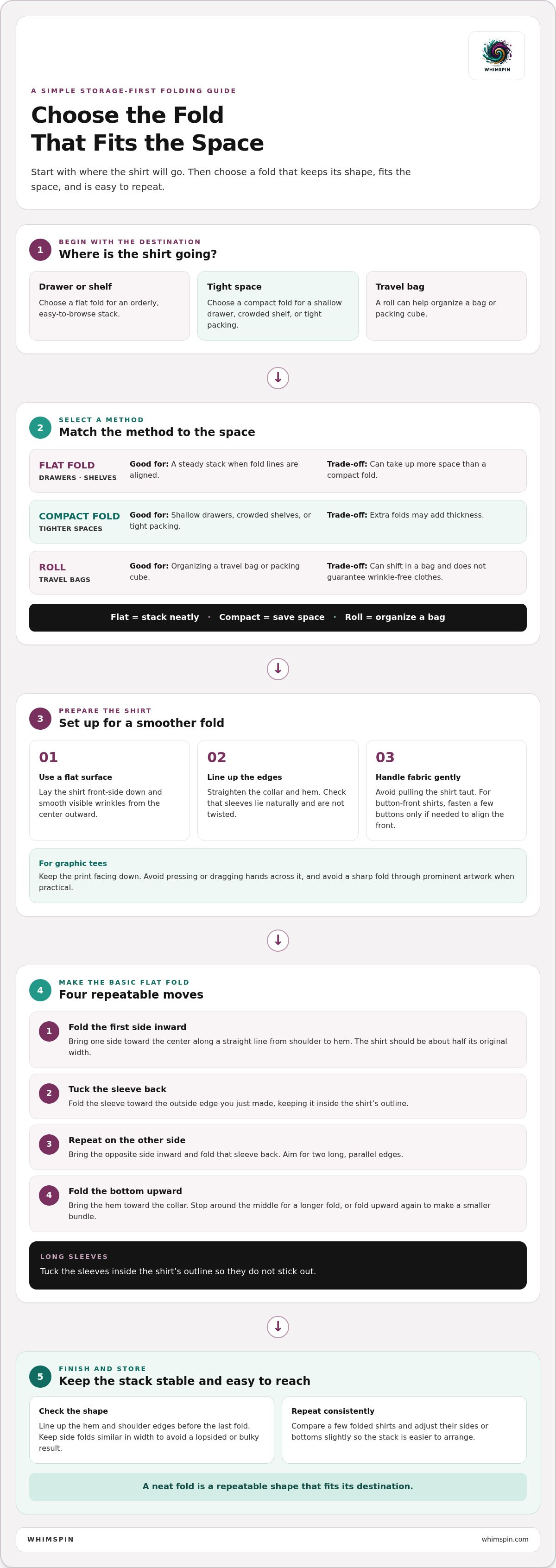
The best method depends on where the shirt is going. A flat fold makes a steady stack, a compact fold fits tighter spaces, and a roll can help organize a travel bag. No method works best in every situation. Choose based on the destination, then use a consistent approach so your drawer or luggage stays organized.
| Method | Best for | Ease of stacking | Trade-off |
|---|---|---|---|
| Flat fold | Drawers and shelves | Easy to stack when folds are aligned | Can take up more space than a compact fold |
| Compact fold | Shallow drawers, crowded shelves, or tight packing | Stacks neatly if each shirt is folded to a similar size | Extra folds may add thickness |
| Roll | Travel bags and packing cubes | Less suited to a tall, stable stack | Can shift in a bag and doesn’t guarantee wrinkle-free clothes |
Which fold works best in a drawer or on a shelf?
For orderly storage, choose a flat fold. Matching the shirt’s width and fold lines makes a stack easier to browse without disturbing every shirt to find the one underneath. If drawer height or shelf space is limited, use a compact fold instead. The smaller shape can fit tighter spaces, though it may feel thicker. Fold shirts with similar shapes the same way, so one oversized bundle doesn’t destabilize the stack.
Still deciding how to fold a shirt for everyday storage? Choose a flat fold for an orderly stack, or a compact fold when fitting more into limited space matters most.
Should you roll shirts for travel?
Rolling can make it easier to arrange shirts side by side in a bag, especially if you want to see what you packed. It’s an option, not a wrinkle-proof trick. Tight packing, movement, and the fabric itself can still leave creases.
- Smooth the shirt on a flat surface.
- Fold both sides inward so the sleeves sit within the shirt’s outline.
- Starting at the hem, roll steadily toward the collar without pulling the fabric taut.
Planning outfits before you pack helps you choose which graphic tees to bring and keep the bag organized. Pair your packing plan with graphic tee outfit ideas. Choose the fold for the job: flat for stacks, compact for tight spaces, and rolling for packing flexibility.
How to Fold Long-Sleeve and Graphic Shirts with Care
Long sleeves add extra fabric to manage, while a bold print gives you another detail to consider. The goal is the same for both: make a tidy shape without yanking sleeves or pressing hard on the design. A few adjustments make how to fold a shirt easier to adapt to different styles.
How to fold a long-sleeve shirt
Lay the shirt flat and bring one side inward. Fold its sleeve diagonally down across the shirt body, keeping the cuff inside the outline. Repeat on the other side. If a cuff still sticks out, tuck it gently inward before folding the bottom toward the collar. A downward sleeve fold can work well on wider shirts, while a diagonal fold can keep a sleeve contained on a narrower shape.
Before the final fold, check the shirt’s edges. The sleeves shouldn’t poke past the sides, and the cuffs shouldn’t form bulky corners. Fold the bottom upward once or twice to suit your storage space, then compare the finished shape with the shoulders. If one end is wider, adjust the side folds rather than forcing the fabric into place.
How to fold a graphic tee without stressing the print
Start with the tee lying smoothly and settle the fabric with gentle movements. Avoid pressing hard or dragging your hands across raised or prominent print areas. Check where the design sits before choosing fold lines. If practical, shift a side or bottom fold so a sharp crease doesn’t run through the main artwork. Don’t force an awkward shape, though. A neat, stable fold still matters.
For example, an all-over design such as the all-over print scarlet macaw tee spreads the artwork across the shirt instead of concentrating it in one central image. You can still fold it into a rectangle, taking a moment to avoid cutting across a prominent part of the design where possible. Thoughtful folding can reduce unnecessary pressure on the print, but it can’t guarantee the design will stay damage-free.
Explore graphic T-shirts for more designs to make room for in your drawer.
Store Folded Shirts So They Stay Easy to Find
A good fold is only part of the job. Place each shirt where it stays easy to reach without turning the drawer into a toppled stack. Use a simple routine: fold, group, place, and adjust. Choose one repeatable method for similar shirts, then adapt it when a shirt’s shape or storage space calls for a change.
How to organize a folded-shirt drawer
Group shirts in a way that works for your household. You might sort by wearer, sleeve length, or how often you reach for each one. Keep everyday favorites near the front or on top, and put less-used shirts behind or beneath them. In a shallow drawer, smaller groups can be easier to browse than one tall pile.
Place each shirt so the stack stays stable and accessible. A stack that leans or shifts whenever you take a shirt can undo careful folding in a hurry. Avoid building it higher than you can comfortably manage. If choosing one shirt disrupts the rest, split the pile or adjust the fold size. Keeping similar shirts folded consistently makes the drawer calmer and makes it easier to put each shirt back in its place.
A quick check before putting shirts away
Check the finished fold before putting it away. Make sure sleeves and cuffs are tucked inside and the edges line up instead of jutting out. For a printed shirt, notice where the artwork falls. If an easy adjustment can keep a sharp fold away from a prominent graphic, shift the fold before placing the shirt in the stack. There’s no need to force an awkward shape; the shirt should still sit securely.
- Fold: Use the same basic method for similar shirts.
- Group: Sort by wearer, sleeve length, or another useful category.
- Place: Keep the stack stable and frequently worn shirts within reach.
- Adjust: Change the fold size if shirts bunch, lean, or feel difficult to retrieve.
With a repeatable routine, learning how to fold a shirt becomes an easy storage habit instead of a fresh puzzle every laundry day. Keep your favorite designs ready for their next outing, and browse graphic tees with personality for more shirts worth making room for.
Make Your Next Laundry Fold a Little Easier
A neater drawer doesn’t require one perfect technique for every shirt. The key to how to fold a shirt is matching the fold to its destination: use a flat fold for an orderly stack, a compact fold when space is tight, and a roll when it suits your travel bag. Keep the basic sequence consistent, then adjust the finished size to fit the space.
For short sleeves, fold both sides inward and bring the hem up. For long sleeves, tuck the cuffs inside the outline before folding. With graphic tees, handle the print gently and shift a fold line away from prominent artwork when practical. Then group similar shirts and place the ones you reach for most where they’re easy to grab. Small habits mean less drawer chaos.
Ready to add a graphic tee with personality to your rotation?
Pick a method, make it your routine, and enjoy opening a drawer that’s ready for the day. Your shirts, and your mornings, will feel a little more together.
Frequently Asked Questions
How do you fold a shirt quickly?
Lay the shirt flat and smooth it, then fold both sides and sleeves inward before bringing the hem toward the collar. Use the same sequence instead of chasing a perfect shape. For extra speed, repeat it for shirts of similar size. Check that the edges line up, and you’re done. A steady routine beats reinventing the fold every laundry day.
What is the best way to fold shirts for travel?
For travel, fold shirts into compact rectangles or roll them after folding the sides inward. Choose based on your bag and how you want to organize it: rectangles can stack, while rolls can sit side by side. Rolling doesn’t guarantee wrinkle-free clothes. Smooth each shirt before folding, and avoid overpacking so shirts aren’t compressed into every available corner.
How can you fold a shirt without making wrinkles?
Start with a smooth, dry surface and gently flatten the shirt before folding. Align the sides and sleeves instead of bunching the fabric, and avoid pressing hard along every crease. The result also depends on the shirt and how it’s stored, so leave room in the drawer or bag rather than compressing the stack. Careful folds can help keep things tidy, but they can’t prevent every wrinkle.
How do you fold a graphic T-shirt without creasing the design?
Lay the shirt flat and smooth it gently before deciding where the folds will fall. If practical, avoid placing a sharp fold directly through a prominent part of the design. Fold the sleeves and sides inward, then adjust the final fold to fit your storage space. Treat this as a thoughtful way to store a favorite graphic tee, not a substitute for following the garment’s care instructions.
How do you fold a long-sleeve shirt neatly?
Lay the shirt flat, then fold one sleeve inward along the shirt body and tuck its cuff within the outline. Repeat on the other side, straightening each sleeve so it doesn’t bunch. Fold the hem toward the collar, using one or two folds to suit the shirt’s length and storage space. Before putting it away, check that neither cuff sticks out and the finished shape looks even.
Is rolling shirts better than folding them?
Neither method is best for every situation. Flat folds can create tidy stacks, while compact folds or rolls may help organize a packed bag. The right choice depends on your available space, shirt shape, and how you prefer to find your clothes. Rolling isn’t a guarantee against wrinkles. Smooth shirts before packing and avoid overfilling your bag, whichever method you choose.


